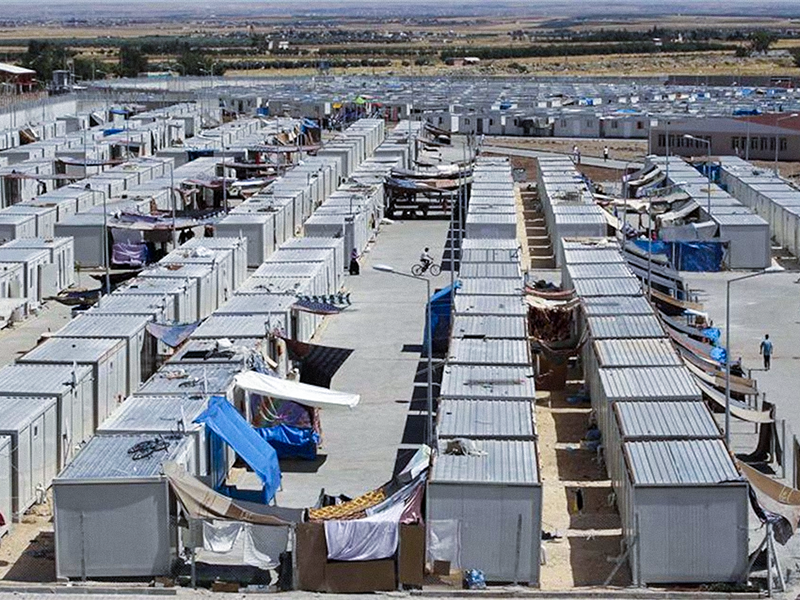

8,000 Prefab Container Homes for Extreme Cold How CGCH Delivered Modular Container Housing in Russia’s Harsh Winter Climate
8,000 Prefab Container Homes for Extreme Cold
How CGCH Delivered Modular Container Housing in Russia’s Harsh Winter Climate
When Construction Enters the World’s Coldest Frontlines
As global demand grows for prefab container homes, modular container homes, and fast-deploy housing systems, one question increasingly defines the industry:
Can container homes truly perform in extreme cold climates?
Russia offers the most demanding answer.
With winter temperatures reaching -45°C, prolonged snow cover, frozen soil, and strong winds, Russia represents one of the harshest environments for any type of housing—especially shipping container homes and prefab shipping container houses.
In this context, CGCH, a professional manufacturer of prefab container homes and modular container house systems, successfully delivered 8,000 high-performance container homes in the Alabuga Special Economic Zone (SEZ), Republic of Tatarstan.
This project has become a benchmark for container homes in cold climates, proving that industrialized modular construction can outperform traditional buildings under extreme winter conditions.

Chapter 1
Why Extreme Cold Is the Ultimate Test for Container Homes
1.1 Cold Climate Is a Systemic Challenge, Not Just Insulation
Many discussions around container home design oversimplify cold weather performance as an insulation issue. In Russia, this assumption fails quickly.
In regions such as Tatarstan, winter conditions combine:
•Sustained temperatures of -35°C to -45°C
•Heavy snow loads and wind pressure
•Deep seasonal frost and freeze–thaw cycles
•Limited daylight and short construction windows
For cargo container homes or modular container homes, these conditions affect not only comfort, but structural stability, airtightness, thermal bridging, foundation behavior, and long-term energy consumption.
Without climate-specific engineering, even well-designed container home plans can suffer from heat loss, condensation, and rising operating costs.

1.2 Why Traditional Construction Struggles in Extreme Cold
In Russia, traditional building methods face structural limitations:
•Concrete and masonry construction becomes weather-dependent
•On-site insulation quality is inconsistent
•Construction cycles are restricted to short seasonal windows
•Heating energy often exceeds 70% of total building energy use
As a result, the cost of container homes—when designed correctly—can be significantly lower over the full lifecycle compared to conventional buildings.
This reality is driving increased adoption of prefab container homes, storage container houses, and modular container housing across industrial zones, campuses, and workforce accommodations.

Chapter 2
From Shipping Container to Integrated Housing System
2.1 Designing Prefab Container Homes for Climate, Not Transport
In the Alabuga project, shipping containers were not treated as finished buildings, but as standardized structural modules.
CGCH developed a cold-climate system architecture based on five integrated layers:
①Structural system – high-strength steel frames designed for snow loads and thermal movement
②Thermal envelope – continuous insulation eliminating cold bridges
③Connection system – low-temperature-tolerant joints with installation tolerance
④Functional integration – factory-installed heating, plumbing, and electrical systems
⑤Operational efficiency – reduced heating demand and simplified maintenance
This approach transforms prefab shipping container homes from temporary shelters into long-term modular housing solutions, suitable for student dormitories, workforce housing, and even luxury shipping container homes.

2.2 Why Cold-Climate Performance Is About Systems, Not Thickness
Below -30°C, simply adding insulation is not enough.
High-performing modular container homes must prioritize:
①Continuous insulation instead of localized reinforcement
②Thermal bridge prevention rather than post-installation fixes
③Airtightness over wall thickness
④Factory precision instead of on-site adjustments
This system logic also supports scalable layouts—from single container homes to 40 ft container homes, multi-unit clusters, and expandable configurations.

Chapter 3
Industrialized Construction: How 8,000 Homes Were Delivered Through Winter
3.1 High Prefabrication Rates Reduce Climate Risk
Over 95% of construction processes for the Alabuga project were completed in CGCH’s factory.
This ensured:
①Welding, insulation, and sealing unaffected by winter weather
②Consistent quality across thousands of units
③Minimal on-site labor exposure in extreme cold
Whether producing 20 foot container homes, 40 ft container homes, or large-scale container home kits, the same production standards applied.
3.2 Fast Installation Without Winter Dependency
With pre-installed interfaces and modular connection systems, on-site installation remained efficient even under low visibility and freezing temperatures.
This method is widely applicable to:
①Student housing container homes
②Industrial worker camps
③Emergency and rapid-deployment housing
Chapter 4
The Alabuga Case Study: Real Performance of 8,000 Container Homes
4.1 Project Overview
•Location: Alabuga SEZ, Republic of Tatarstan, Russia
•Scale: 8,000 prefab container homes
•Total Area: Approx. 110,000㎡
•Function: Student dormitory housing
4.2 Living Experience as the Final Benchmark
After occupancy, the modular container homes demonstrated:
•Stable indoor temperatures throughout winter
•Lower heating energy consumption than nearby traditional buildings
•Efficient layouts balancing privacy and shared spaces
•Simplified long-term operation and maintenance
This confirms that well-engineered modern container homes can deliver comfort comparable to conventional buildings—even in extreme climates.

Chapter 5
What This Project Means for the Global Container Home Industry
5.1 A Proven Model for Cold-Climate Container Homes
The Alabuga project provides a repeatable model for:
•Cold-region student housing
•Energy, mining, and industrial worker camps
•Industrial park residential support
•Emergency housing deployment
It also reinforces the competitiveness of Chinese prefab container homes, offering end-to-end solutions from container home plans and shipping container home designs to manufacturing and delivery.
5.2 Modular Container Homes Are Becoming the Optimal Choice
In extreme environments, modular container homes are no longer alternatives—they are often the most reliable solution.
CGCH continues to supply a full spectrum of products, from affordable container homes and cheap shipping container homes to fully customized, high-performance modular housing systems.
Frequently Asked Questions About Prefab Container Homes in Cold Climates
①Are prefab container homes warm enough in winter?
Yes. When designed with continuous insulation, airtight construction, and integrated heating systems, prefab container homes can perform reliably even below -45°C.
②What insulation is used in cold-climate container homes?
High-performance multi-layer insulation systems combined with thermal bridge control and airtight membranes are essential for cold climates.
③How much does a container home cost in extreme cold regions?
The container home cost depends on insulation level, heating systems, and layout. However, lifecycle costs are often lower than traditional buildings due to faster construction and reduced energy consumption.
When Warmth Is No Longer Limited by Latitude
As winter once again covers Russia in snow, rows of prefab container homes stand quietly in Alabuga SEZ.
They are not temporary shelters—but engineered modular housing systems designed to thrive where conventional buildings struggle.
The 8,000-unit project proves one thing clearly:
A well-designed prefab container home is not a compromise. It is the optimal solution.
If you are evaluating prefab container homes, modular container housing, or shipping container home solutions for cold climates, CGCH provides direct factory-to-site support, from design to delivery.

CGCH — We Create the Space. You Create the Future.
Email: cgch-ceo@cgchcontainer.com
Website: https://cgchcontainer.com/
Factory Location: Huainan / Suzhou / Foshan
Huainan showroom:
https://www.720yun.com/vr/3b1j5OsuOw3
Suzhou showroom:
https://www.720yun.com/vr/b00j5OyOsm8
Foshan showroom: